Perfect Score Feature · November 2026
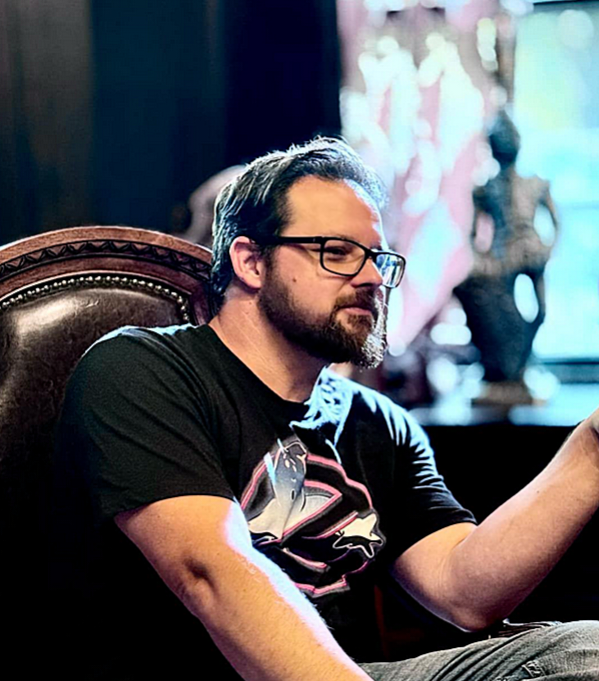
Kris McMenamin: Flawed Things Can Still Be Beautiful
A Philadelphia-suburbs filmmaker who didn't put a page down until his late thirties — and just earned a perfect 300 with Death's Guide to Living.
300 / 300
DEATH'S GUIDE TO LIVING
Road-trip romance
290.6
THE LONG WAY THROUGH
Survival thriller · in financing
Editor's note
Kris McMenamin writes about a reaper who can't go through with it, and about the people standing next to grief, cracking jokes they shouldn't. With Death's Guide to Living, he became only the second writer ever to earn a perfect 300 out of 300 on Scriptageddon.
What moves me most is how he got here. He kept these stories in his head for years until his wife told him to go for it. He rebuilds structure instead of polishing lines, and he'll gut a scene he loves if the story needs it. Death's Guide to Living climbed from 279.9 to 286.6 to 300, and his survival thriller The Long Way Through scored 290.6. That's not luck. That's a writer doing the hard work again and again.
Kris joins Joseph Sumbi and Holly Fouche at the top of our Wall of Fame. Kris, thank you for your honesty, your big heart and your reminder that flawed things can still be beautiful. Philly should be proud of you, and so are we.
— Angelo Rocha, Scriptageddon
In his own words
"I'm chasing those moments, not perfection."
1. Where are you from, and how has that place shaped your writing?
I'm from the Philadelphia suburbs. Other than a brief stint near DC, I've lived here my whole life. Philly and the surrounding area have a specific feel — we're a bit rough around the edges, but the bonds people form here are among the strongest I've seen. There's this tough, honest, almost reluctant kindness that's always been in my life, and it permeates every character I write. Found family is a big thing here. Not blood, but the people you chose and who chose you back. We take that seriously, and it touches everything I do.
2. What first made you want to tell stories? Do you remember the moment?
I always had ideas. I'd write things in my head, play out scenes, build characters — but none of it ever hit a page until my late thirties. What changed was my wife. She encouraged me, told me it was worth doing, told me I could do it. She's always been the reason I'll take a leap — because she already took the leap and was waiting for me to catch up. Her faith in me has always been bigger than mine. When I thought about doing my first film, she was the one who said go for it. So I did.
3. Tell us about Death's Guide to Living. Where did the idea come from, and what is it really about for you?
It started as a feature script called Death's Bad Day. The premise was weird but simple, which is normal for me — what happens when a reaper gets assigned to collect someone and can't go through with it? But the story I actually ended up writing was a road-trip romance. A woman who's never been human and a man who's about to stop being one, driving across small-town America, eating at diners, arguing about what hunger feels like. The cosmic stuff is the container. What it's really about is the line I keep coming back to in everything I write: flawed things can still be beautiful. Not despite being broken. While still broken.
The novel let me live inside that idea longer than a screenplay does. When I finished the script, I could already see book two and book three — there was so much left to write that it got me excited in a way I hadn't felt before with the featured script that I knew was done, there is a sequel, but this felt like it has volumes to tell.
4. Death shows up as a character in more than one of your scripts. What draws you to that subject?
I'm not so much drawn to death as a subject. I'm drawn to what people do next to it. Death and grief are universal, but no two people go through them the same way, and that's where the interesting stuff lives. The funniest things I've ever seen happen at funerals. The most honest things people say come out when someone's leaving or already gone.
My first feature, Misfits, has a graveside scene where two guys are riffing about Beetlejuice four feet from a widower, and then the grief hits and it's genuinely ugly. That wasn't a tonal choice I made on purpose the first time — it's just how I saw it. People don't schedule their humor around convenient tonal breaks. It slips out at the worst and best times. So death keeps showing up because it's the best pressure test I know for whether characters are real.
5. What does your writing process look like? When and where do you write best?
I sit on an idea for a while first. I play it in my head, think of all the different directions it could go, and when I feel like there's enough there, I write an outline and the punchy scenes — the parts I think are the best of a potential story. Once that skeleton is in place, I draft my favorite scenes, then figure out what connective tissue needs to go in the middle and how to build the arcs that mean the most to me. Then I rewrite, inspect, find the holes and the things that are lacking, and rewrite again. Then three days later I'll think of something and have to rewrite again.
I write best sitting across from my wife while she's reading her book, or while we're watching TV. My dogs are often making the keyboard tough to get to, or I'm writing at some unnatural angle, but I'm surrounded in the best way possible.
6. Which films, writers or books made you who you are as an artist?
The things that hit me hardest were never the perfect ones. I don't think The Godfather or Schindler's List shaped me as much as Dodgeball, About a Boy, Blues Brothers, Gremlins, Ghostbusters, Saved!, or This Is Where I Leave You. Those are amazing works of art, the former ones, but it's the somewhat flawed films — the weird small drama or comedy moments that really made me feel something — those are what stuck with me forever. I think that's why I write what I write. I'm chasing those moments, not perfection.
7. What's the hardest lesson writing has taught you?
You are not as good or as bad as your head is telling you. Also, that so much of writing is rewriting, and patience is required even when you can't stand it.
8. What does rewriting mean to you? How do you know when a draft is finally right?
Rewriting is where the actual writing happens. First drafts are you finding out what the story is. Everything after that is you earning it. I'll rewrite a script four, five, six times before I'd show it to anyone. And I mean real passes — not polishing dialogue, but tearing out structure and rebuilding it. The Long Way Through scored a 290.6 here, but I had rewritten that script five times before I even submitted for coverage. Death's Guide to Living went from a 279.9 to a 286.6 to a 300, and I'd already rewritten it three times before starting that journey. It's not tweaking. It's taking a hard look at it and gutting what doesn't work, even if you like it, and finding what's right for the story — not what's a cool beat.
How do I know when it's right? When I stop finding things that bother me. Not when it's perfect — when every choice is deliberate and I can defend every one of them.
9. Outside of writing, what keeps you going? Who or what inspires you?
My wife. As I said, she's the best support I could have asked for. My family and friends inspire me with ideas — not directly, most of the time. It's a tangent based off something that spiraled off something else. I write because I think stories and characters can create visibility and empathy, and that when you tell a good story it creates a space where people can explore themselves, for better or worse.
10. What's next for you, and what do you hope your work leaves behind?
I'm financing my second feature, The Long Way Through — an elevated survival thriller with recognizable cast attached, fully packaged, most of pre-production completed, and working through the funding process. I'm finishing up Death's Guide to Living and hoping to find representation for myself and the novel. I've got a backstage musical with some songs I wrote, and several other film and TV series scripts I'm floating around. I'm always writing, so probably more of everything. The honest answer to "what's next" is: all of it, at once, all the time.
What I hope the work leaves behind — I want someone to watch one of my films or read one of my stories and feel like the people in it were real. Not "well-written characters." Real people they'd recognize. Maybe it creates a space in their mind after watching or reading it that lets them find something they need.
11. What would you tell a writer who's thinking about giving up?
Be realistic with your expectations, but don't stop dreaming. Keep making things — not because it will get you a deal, but because you enjoy it, but don't spend more than you can as a filmmaker. If a deal comes, great. But writing is fun, it's hard, it's sad, and expressing yourself matters whether or not anyone's buying.