Writer of the Month · October 15 – November 15, 2026
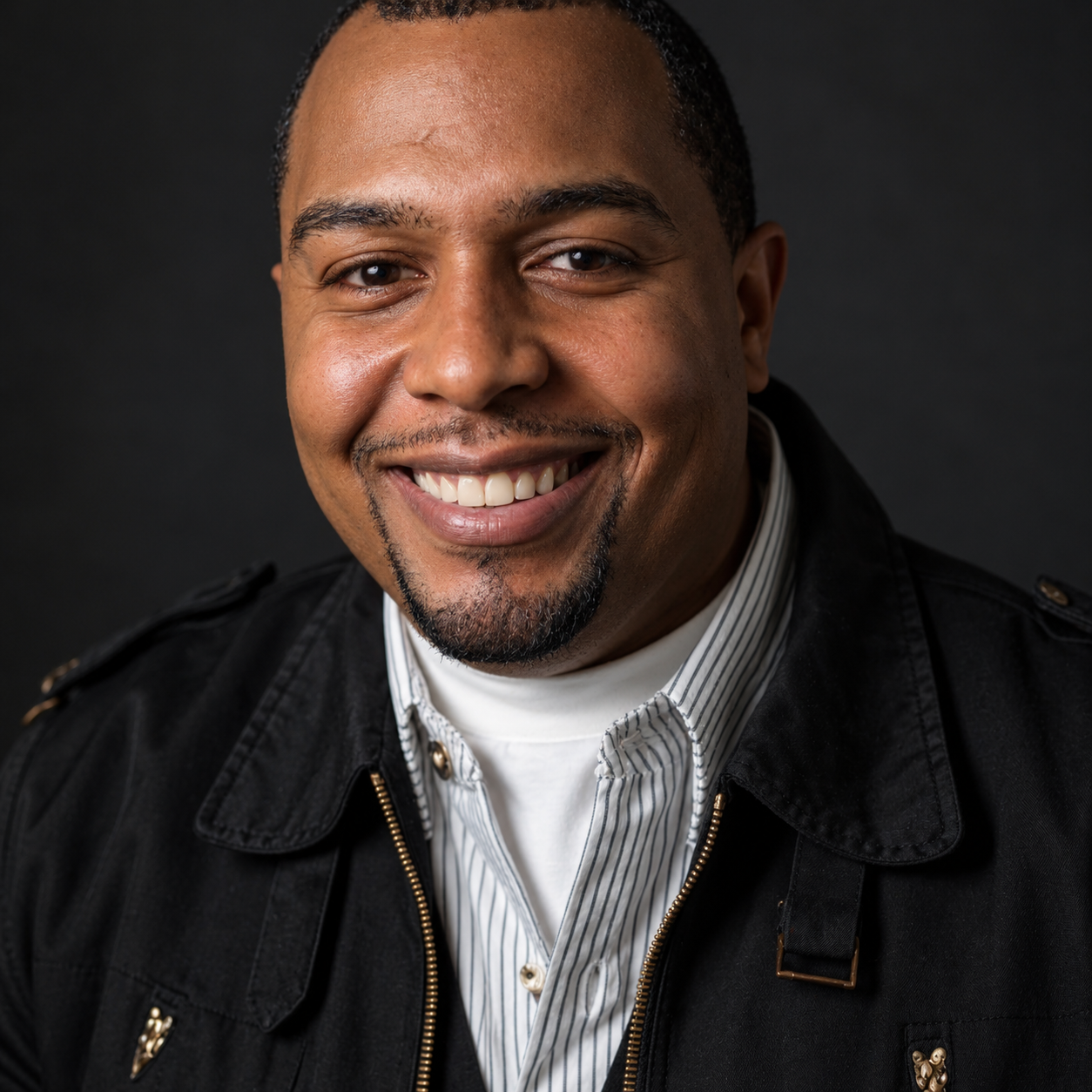
Joseph Sumbi: The First Perfect 300 — Twice
From a writer who once avoided the script to the first screenwriter to earn a perfect score on the 300-point scale, with DOWNWIND and then ZEBRA.
300 / 300
DOWNWIND
Feature · climate thriller
300 / 300
ZEBRA
Feature
Editor's note
Every so often a writer reminds you why this place exists. In November, Joseph Sumbi became the first writer in Scriptageddon history to earn a perfect 300 out of 300 — with DOWNWIND, a storm-soaked story about guilt, truth and a community left downwind of someone else's choices. Days later, he did it again with ZEBRA, a completely different screenplay.
One perfect score is history. Two, on two very different stories, is a body of work. And it came from a writer who, for years, was too afraid to write the script at all — who taught himself from the ground up, wrote through late nights after full days, took hard notes without losing his voice, and kept going.
Joseph stands alongside Holly Fouche, who earned the first perfect 225 on our original scale. Both now lead our Wall of Fame. Joseph, thank you for trusting us with your pages, and for showing every writer who reads this what steady, honest work can do. Vallejo has every reason to be proud.
— Angelo Rocha, Scriptageddon
In his own words
"To go from starting DOWNWIND in May, not knowing whether I could make the idea work, to having it receive a perfect score in November has been an incredible experience."
1. Where are you from, and where do you write from today?
I'm from Vallejo, California, and it's still where I live and do my writing today. Vallejo is home to me, and I'm extremely proud to be from here.
One thing I've always loved about Vallejo and the Bay Area is the diversity. There are so many different cultures, backgrounds, and experiences that make this place special. I really want to represent my city well. I want people to know that talented writers, filmmakers, and artists can come from places like Vallejo too.
I understand that so much of the film industry is based in Southern California, and I'm more than willing to go wherever the opportunities take me. But no matter where this journey leads, Vallejo and the Bay Area will always be home.
I'd love to reach a point in my career where I can make my hometown proud.
2. How did you start writing screenplays?
I've always loved movies and storytelling, but for the longest time, I was actually afraid to write a screenplay. I had worked on short films as a director and producer, and whenever it came time to write the script, I was more than happy to let somebody else in our filmmaking group handle it.
I knew how important a screenplay was to the success of a film. To me, it was the foundation of everything. If the story wasn't good, it didn't matter how well you shot it. And honestly, I didn't want to be responsible for writing a bad screenplay and having everybody blame me if the movie didn't turn out the way we hoped. So I stayed away from that part of filmmaking for a long time.
That changed during COVID, when everything shut down and I suddenly had more time to myself. I had been carrying around ideas for ZEBRA and EQUAL OPPORTUNITY for years, even before the pandemic. I finally decided to dust them off and see if I could turn them into actual screenplays.
I didn't have any formal training in screenwriting, so I started watching YouTube videos. Lots of them. Anything I could find about screenplay structure, formatting, dialogue, character development, and how professional writers approached their work. I wanted to learn how to write a screenplay the right way, or at least get as close to professional quality as I could.
For a while, I was writing strictly for my own enjoyment. I wasn't showing my scripts to anyone because I genuinely didn't know whether what I was writing was any good. Eventually, I discovered websites like Scriptageddon, which gave me a way to get feedback and see whether I was actually improving.
That's something I'm really grateful for. When you're writing by yourself and don't have people around you who can evaluate your work, it's difficult to know whether you're moving in the right direction. Having a place where writers can submit their work, receive feedback, and measure their progress means a great deal. It certainly has to me.
It's funny to think that I spent so many years avoiding screenwriting because I was afraid of doing a bad job. Now it's one of the things I enjoy doing most.
3. What is DOWNWIND about, in your own words?
DOWNWIND is about a woman who has spent seven years living with a decision she knows was wrong.
Nadine Brooks is a maintenance supervisor at a refinery who falsified a safety test years earlier. When a major storm threatens the predominantly Black community where she grew up, she discovers that her decision may have put hundreds of people in danger.
Now she has to decide whether she's willing to tell the truth, even if it means losing her career, her freedom, and potentially affecting the livelihoods of hundreds of workers.
But for me, the movie is really about accountability.
It's about how difficult it can be to admit you've done something wrong, especially when you've spent years convincing yourself that you had a good reason for doing it. I also wanted to explore what happens when communities are forced to live with the consequences of decisions they had no say in making.
4. Where did the idea come from?
The idea actually started in late May 2026, when I came across a post about the 2027 NRDC Climate Storytelling Fellowship. I thought it sounded like an interesting opportunity, but I also saw it as a personal challenge. I wanted to see if I could write a compelling feature film with a female lead while building the story around climate change and environmental justice.
I'll admit, I had no idea what the story was going to be when I started. That was probably the hardest part. I was essentially staring at a blank page and trying to figure out how to tell an original story within a specific subject. I didn't want climate change to feel like the lesson of the movie. I wanted it to be part of what made the movie exciting, emotional, and worth watching.
I spent a lot of time exploring different ideas and getting guidance. Some ideas sounded interesting at first, but the more I thought about them, the more I realized they weren't stories I wanted to spend months writing. Eventually, I started thinking about a woman who discovers something terrible about the company she works for.
Then I asked myself what would happen if she wasn't innocent. What if she had actually played a part in creating the problem she was trying to expose? That's when everything started coming together. Once I understood who Nadine was and what she had been hiding, I finally felt like I had found the story I wanted to tell.
5. How long did it take, from the first page to this draft?
I started developing DOWNWIND in late May 2026, and it took me until the beginning of November to reach a version I genuinely felt proud to say I had written.
So roughly five months.
And those weren't five months where everything came together smoothly.
I went through a lot of drafts. There were plenty of times when I thought I'd finally figured out a scene, only to read it again the next day and realize it still wasn't working. Sometimes the dialogue sounded unnatural. Sometimes the pacing was off. Other times I realized a character was making a decision simply because I needed the story to move forward.
I also received feedback that made me reconsider parts of the screenplay I thought were already finished. That wasn't always easy, but I tried to take the criticism seriously without losing the story I originally wanted to tell.
Looking back, I think the biggest thing that helped me finish DOWNWIND was simply refusing to give up on it. I knew there was a good story in there somewhere. I just had to keep working until I found the best way to tell it.
6. What does your writing day look like?
A lot of late nights.
I have responsibilities during the day, so nighttime is usually when I have the most freedom to sit down and write without worrying about everything else I need to get done. Once things get quiet, I can really focus.
Sometimes I'll start writing with the intention of working for an hour or two, and before I know it, I've been sitting there most of the night. There have definitely been mornings when I've looked at the clock and realized I was going to have to get through the day on only a few hours of sleep.
And believe me, I feel it the next day.
There are times when I'm a complete wreck because I spent most of the night working on a screenplay. But when I'm making progress on a story, it's difficult to walk away from it.
I might be trying to fix a scene, figure out a character's motivation, or rewrite a conversation that just doesn't sound right. Sometimes I'll tell myself I'm going to make one small change, and three hours later I'm still working.
I know I could probably do a better job balancing my writing with getting enough rest, but those quiet hours have become really important to me. There's something satisfying about finally getting a scene to work after spending hours trying to figure it out. Even on the days when I'm exhausted, I still feel like the effort is worth it.
7. Which films or writers shaped you most?
There are so many filmmakers whose work I admire.
Quentin Tarantino, David Fincher, Spike Lee, Steven Spielberg, Martin Scorsese, and Paul Thomas Anderson are some of the directors who have had the biggest influence on the way I think about movies.
Some of my favorite films are Pulp Fiction, The Social Network, Jurassic Park, Malcolm X, and Boogie Nights. But if I had to pick my favorite movie of all time, it would be Goodfellas.
I absolutely love that movie.
There's something about the way Martin Scorsese tells a story that has always fascinated me. His movies have so much personality, energy, and emotion. Even when he's telling stories about people who do terrible things, he has this incredible ability to make you interested in their lives.
And what amazes me about Scorsese is that even as he's gotten older, his films haven't lost that edge. He can still make a movie that feels raw and emotionally powerful. I can watch one of his newer films and still feel the same excitement and emotional connection that I get from his earlier work. That kind of longevity and dedication to filmmaking is something I really admire.
As far as screenwriters go, Aaron Sorkin, Quentin Tarantino, the Coen Brothers, Steven Zaillian, Paul Thomas Anderson, and John Hughes are among my favorites.
I love Sorkin's dialogue, Tarantino's ability to create unforgettable conversations, and the way the Coen Brothers can make something funny, unsettling, and completely unpredictable at the same time.
I also admire how writers like Zaillian and Paul Thomas Anderson build complicated characters and how John Hughes could make ordinary relationships feel so important.
The thing I take away from all these filmmakers is that there isn't just one way to tell a great story. I want to learn from the people I admire, but I also want my own work to feel like something that came from me.
8. What's the hardest part of writing for you, and how do you push through?
Knowing when something is actually finished.
I can spend hours working on a scene and feel really good about it. Then I'll read it again the following day and realize it still needs work. I think one of the hardest things about writing is learning not to become too attached to what you've written.
Sometimes you'll have a line of dialogue you absolutely love, but it doesn't belong in the scene anymore. Other times, you might realize an entire scene isn't doing anything for the story. That can be frustrating because you remember how much time you spent writing it.
I've also had to learn that receiving criticism doesn't mean I'm a bad writer. That might sound obvious, but considering how nervous I used to be about writing screenplays in the first place, it took some time for me to really understand that. Now I try to look at feedback as an opportunity to improve.
I don't automatically agree with every suggestion, but I do try to understand what isn't working for the reader. When I get stuck, I go back to the basics. What does the character want? What's preventing them from getting it? And why should the audience care? Usually, somewhere in those questions, I can find my way forward.
9. What's next? More scripts, competitions, representation, production?
Hopefully all of the above.
My immediate goal is to find representation and put myself in a position where I can get ZEBRA or DOWNWIND made into a feature film.
I've spent so much time developing these stories, and I'd love the opportunity to see them come to life. I'm also continuing to work on other projects, including EQUAL OPPORTUNITY, a workplace comedy series.
Receiving perfect scores for both DOWNWIND and ZEBRA has been an incredible experience, especially because they're such different stories.
I'm proud of those accomplishments, but I also understand that getting a screenplay produced is a completely different challenge. I know there's still a lot of work ahead of me.
On a more personal level, though, my biggest motivation is my children. Of course I want to be successful as a writer and filmmaker. I want to make movies, work with talented people, and hopefully build a career doing something I genuinely love. But more than anything, I want to be able to provide a comfortable life for my kids.
I want them to grow up feeling like they have opportunities. I want them to be able to pursue whatever interests them, whether that's college, sports, the arts, or something completely different. I don't want them to feel limited in what they can dream about doing with their lives. That's what I'm really working toward.
Everything I do is for them, and I want to keep working as hard as I can to give them the best life possible.
If I can build a career doing something I love while creating a better future for my children, that would mean more to me than any award or perfect score.
10. What advice would you give a writer just starting out?
Don't let the fear of writing something bad stop you from writing at all.
I say that because I spent years avoiding screenwriting for that exact reason. I was afraid of putting something on paper that other people might think wasn't good enough. Looking back, I wish I had started sooner.
My advice would be to finish your first screenplay, even if you know it isn't perfect. Give yourself something to work with. Then go back and make it better. Learn as much as you can. Read screenplays, watch movies, study how stories are put together, and don't be afraid to ask for feedback.
But also learn to trust yourself. Not every piece of advice is going to be right for your particular story. And don't get discouraged if you aren't where you want to be yet. Everybody starts somewhere. The writers you admire had to learn how to do this too. The important thing is to keep going.
I spent a long time wondering whether I was capable of writing a good screenplay. If I had allowed that fear to make the decision for me, I never would have written ZEBRA, EQUAL OPPORTUNITY, or DOWNWIND.
So if there's one thing I'd tell somebody starting out, it's this. Give yourself a chance to find out what you're capable of.